Notes
three hexagons on a circle solution
Solution to the Three Hexagons on a Circle Puzzle
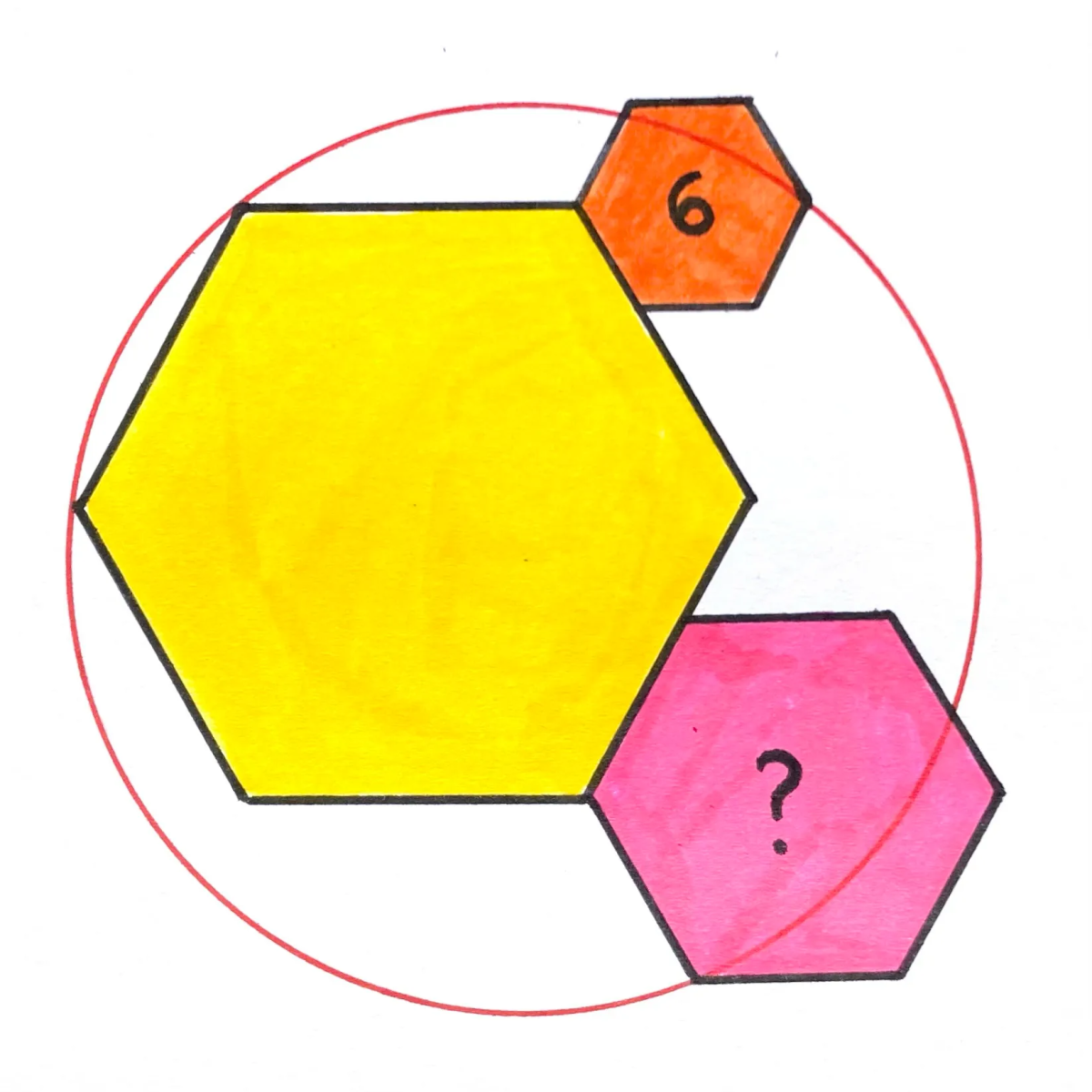
Three regular hexagons. The smallest has area . What’s the pink area?
Solution by Properties of a Regular Hexagon and Angles in the Same Segment
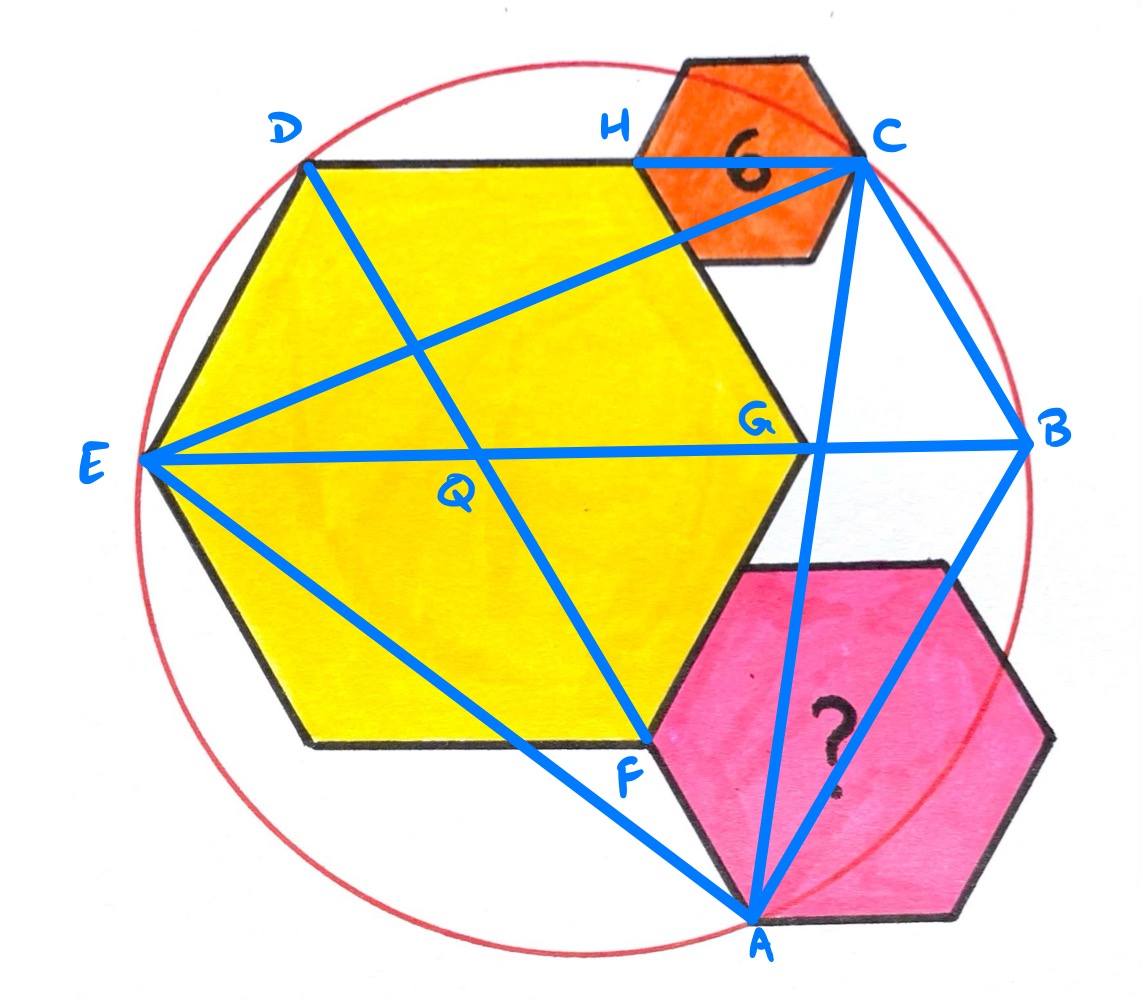
In the above image, is the centre of the yellow hexagon and is where the continuation of line segment meets the circle. Angle is the interior angle of a regular hexagon so is and angle is half that, so is . Therefore, angle is so is a straight line. Similarly, is a straight line.
Since angles in the same segment are equal, angles and are the same. Using angles in a regular hexagon, angles and are both seen to be equal to . So triangles and have the same interior angles and are similar. Then from lengths in a regular hexagon, line segments and have the same length, so triangles and are actually congruent.
This means that line segments and have the same length, then since and have the same length as each other, so also and have the same length as each other. Since the length of is twice the side length of the smaller hexagon, this means that the scale factor from the orange to pink hexagons is , and so the area scale factor is .
Hence the pink hexagon has area .
Solution by Symmetry
With the diagram labelled as above, the circle and yellow hexagon share a line of symmetry which is the perpendicular bisector of . This carries to and so establishes that and have the same length.
Then reflection in the perpendicular bisector of brings to , and reflection in the perpendicular bisector of brings to . Since these perpendicular bisectors are parallel, this establishes and are parallel. Hence is a parallelogram and so and have the same length.
Thus and have the same length so, as above, the hexagons are related by a scale factor of so the pink hexagon has area .
Solution by Invariance Principle
The size of the yellow hexagon is not specified, so it can be varied. Although the size of the orange hexagon is fixed in the puzzle, the key is the relationship between the orange and pink hexagons, so the sizes of all the hexagons can be regarded as variable.
Thus consider the outer circle to be fixed, with a fixed point on its circumference. Let be another point on the circumference. The choice of then determines the rest of the diagram since is a side of the yellow regular hexagon, is found by continuing until it meets the circle, and similarly by continuing .
As moves, the angle remains . By the converse to angles in the same segment are equal, this means that remains fixed in place. A similar argument applied to angle shows that remains fixed in place. So triangle does not move.
Placing half way round the arc from to puts at and at showing that is an equilateral triangle. Then placing at so that the yellow hexagon has no size also brings and to . In this configuration, is the diagonal of the orange hexagon and the side of the pink.
This shows that the scale factor from the orange to pink hexagons is , so the area scale factor is as before.