Notes
multiple semi-circles ii solution
Multiple Semi-Circles II
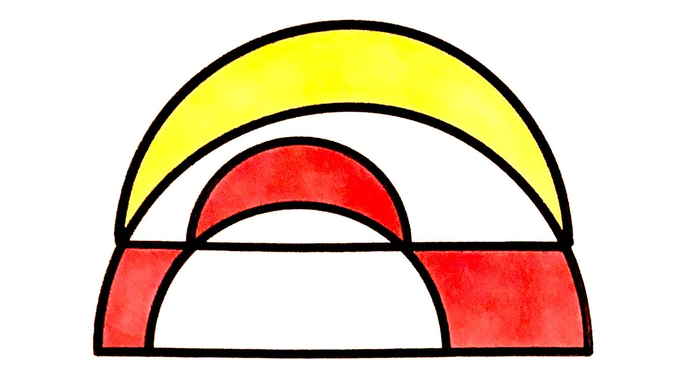
Is more of this design red or yellow?
Solution by Pythagoras' Theorem and the Area of a Circle
Consider first this diagram where all the arcs are semi-circles with parallel diameters and centres at , , and .
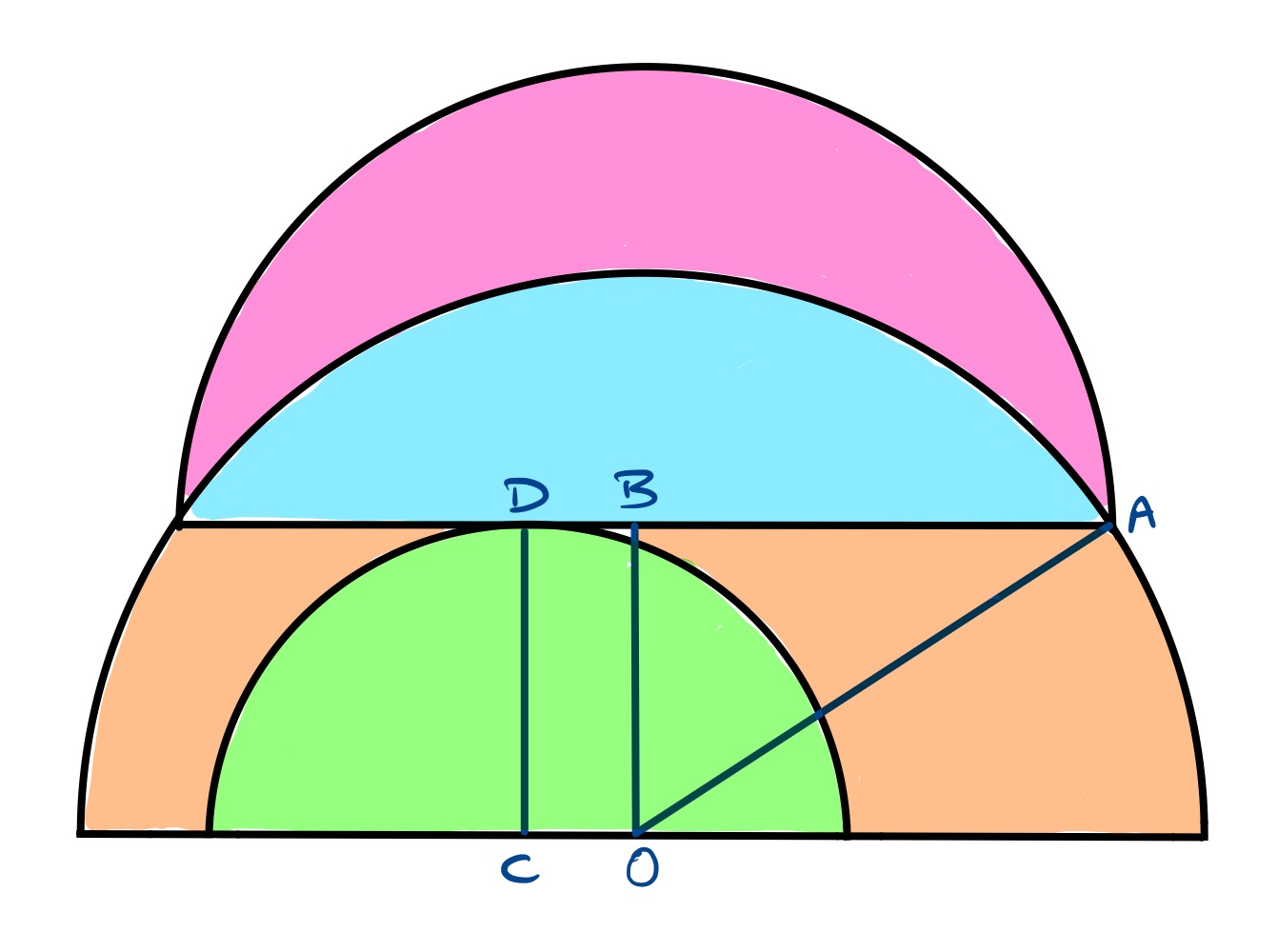
Since the diameters are parallel, is the midpoint of the chord and so triangle is right-angled. Therefore, Pythagoras' theorem applies to triangle . Writing the radii of the circles as , , with the length of , of , and of then this means that:
The area of a semi-circle is times the square of its radius, so from the above then:
which uses the fact that and have the same length. This means that the area of the largest semi-circle is the sum of the areas of the two smaller ones.
In terms of the coloured regions, this means that:
And hence the purple region (which is known as a semi-circular lune) has the same area as the orange.
This applies to the problem as follows.

Using the above calculation of the area of a semi-circular lune, the area of region is equal to the area of the union of regions and . Similarly, the area of region is equal to the area of the union of regions , , and , . Therefore, the yellow and red regions have the same area.